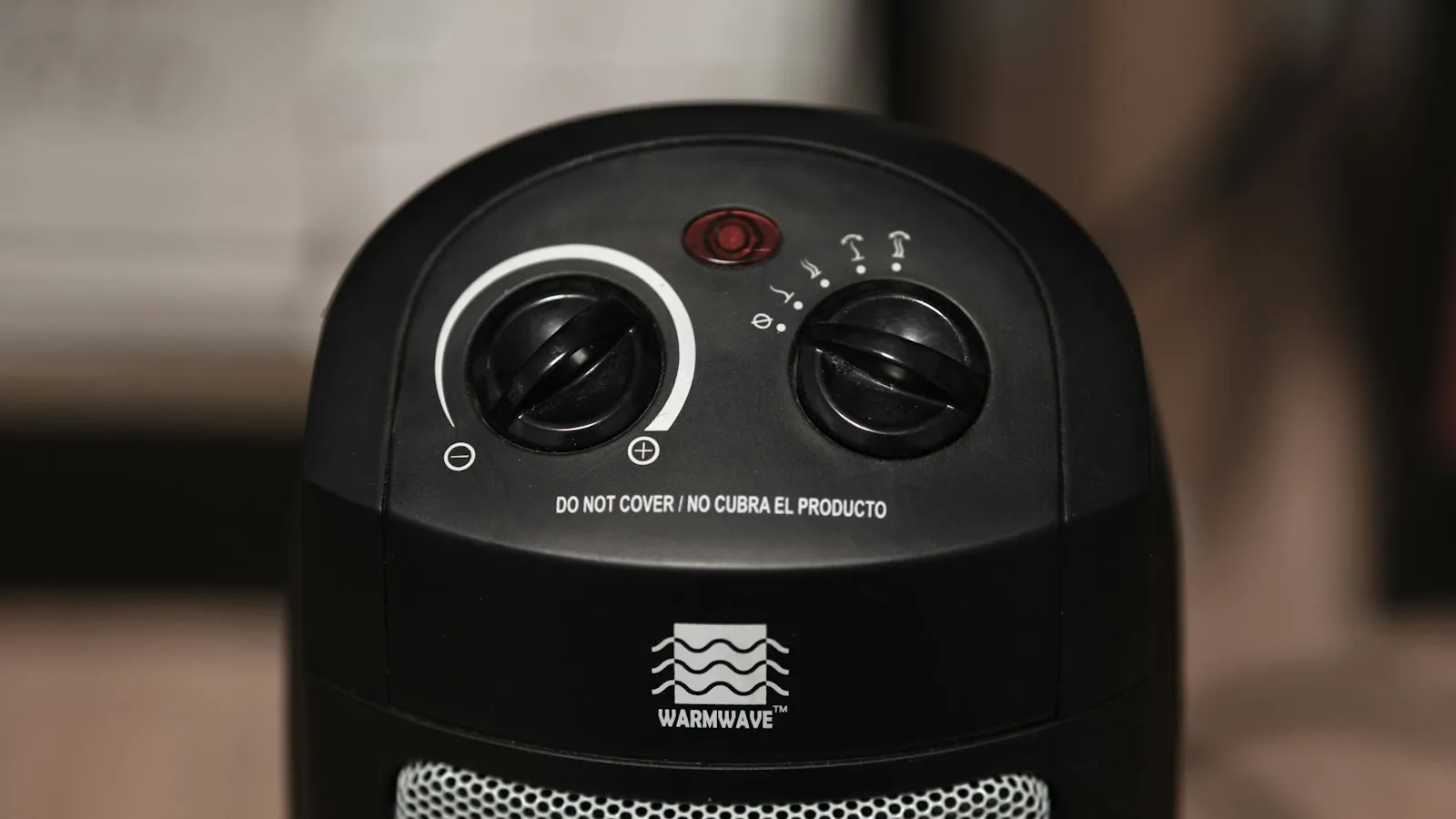
Home Problems
Space Heater Keeps Tripping the Breaker? Causes and Safe Fixes
Space heater tripping the breaker? An overloaded circuit is the usual cause. Check what else shares the circuit, try the low setting and know when it's a fault.
5 min read
Free tool
Find the extension cord gauge for a space heater or other appliance from its watts and the cord length. Shows amps and voltage drop.
Electricity goes out along one wire in the cord and back along another, so the calculator counts twice the cord's length. The resistance of copper wire depends on its gauge, and the voltage lost is the current times the resistance.
Voltage drop = amps x resistance of the wire out and back
Heat in the cord = amps x amps x resistance of the wire out and back
The wire resistance is calculated from the American Wire Gauge definition and the resistivity of copper at 20 degrees C. Stranded cords run slightly higher, and warm cords higher still.
| Gauge (AWG) | Ohms per 1,000 ft of one wire |
|---|---|
| 18 | 6.385 |
| 16 | 4.015 |
| 14 | 2.525 |
| 12 | 1.588 |
| 10 | 0.999 |
| 8 | 0.628 |
| Cord length | 18 gauge | 16 gauge | 14 gauge | 12 gauge | 10 gauge | 8 gauge |
|---|---|---|---|---|---|---|
| 10 ft | 1.3% | 0.8% | 0.5% | 0.3% | 0.2% | 0.1% |
| 25 ft | 3.3% | 2.1% | 1.3% | 0.8% | 0.5% | 0.3% |
| 50 ft | 6.7% | 4.2% | 2.6% | 1.7% | 1.0% | 0.7% |
| 100 ft | 13.3% | 8.4% | 5.3% | 3.3% | 2.1% | 1.3% |
Up to 3 percent is the usual design goal. Over 5 percent is poor. Notice how quickly a thin cord gets worse with length: an 18 gauge cord loses a large share of the voltage at 50 feet, while a 12 gauge cord stays low.
This tool does not say how much current a cord can safely carry. That is set by the rating printed on the cord, and it must be at least the appliance's amps. A heater runs for hours, which warms the cord, so choose heavy duty, keep it short, and check that the cord and plug stay cool.
Fire safety agencies, including the US Fire Administration, advise plugging space heaters directly into a wall outlet and not sharing that outlet with other devices. If a heater keeps tripping the breaker, see why a space heater trips the breaker. To check what else is on the circuit, use the circuit load calculator.
Running a window air conditioner? See why a window air conditioner trips the breaker. For power cuts, the generator size calculator adds up your appliances.
Fire agencies advise plugging a space heater straight into a wall outlet, not an extension cord. If you must use one, many guides recommend 12 gauge or heavier for a 1,500 watt heater, as short as possible, and the amp rating printed on the cord must be at least the heater's 12.5 amps. Retail guidance varies, so check the cord's label.
The cord's wire has resistance, so some voltage is lost along its length and the appliance gets less than 120 volts. A drop under 3 percent is the usual goal. A bigger drop wastes power as heat in the cord.
The watts shown as heat in the cord are lost in the wire. A heavier, shorter cord loses less. A cord that is hot to the touch, or has a warm plug, should be unplugged and replaced.
Yes. Resistance grows with length, so the same current causes a larger drop on a longer cord. Doubling the length doubles the drop. A thicker gauge brings it back down.
No. This tool measures voltage drop and heat. How many amps a cord may carry is set by the rating printed on the cord, so always check that the rating is at least the appliance's amps.
Home Problems
Space heater tripping the breaker? An overloaded circuit is the usual cause. Check what else shares the circuit, try the low setting and know when it's a fault.
5 min read
Home Problems
Window AC tripping the breaker? Check the circuit load, a dirty filter, the plug and the start capacitor first. Here is what to try and when to call an electrician.
5 min read
On the appliance label. A typical space heater is 1,500 watts, which is 12.5 amps.
Printed on the cord or its tag.
Voltage drop is low: 1.3%
Under 3%, the usual goal.
Current
12.5 A
Voltage lost in the cord
1.6 V
Voltage at the appliance
118.4 V
Heat in the cord
20 W
The thinnest gauge that keeps the drop under 3% at 25 ft is 16 gauge. This looks at voltage drop only. It does not tell you how much current a cord can safely carry.
Fire safety agencies advise plugging space heaters straight into a wall outlet, not into an extension cord or power strip. If you must use a cord, keep it short, heavy duty and rated for the load, and check that the plug and cord stay cool.