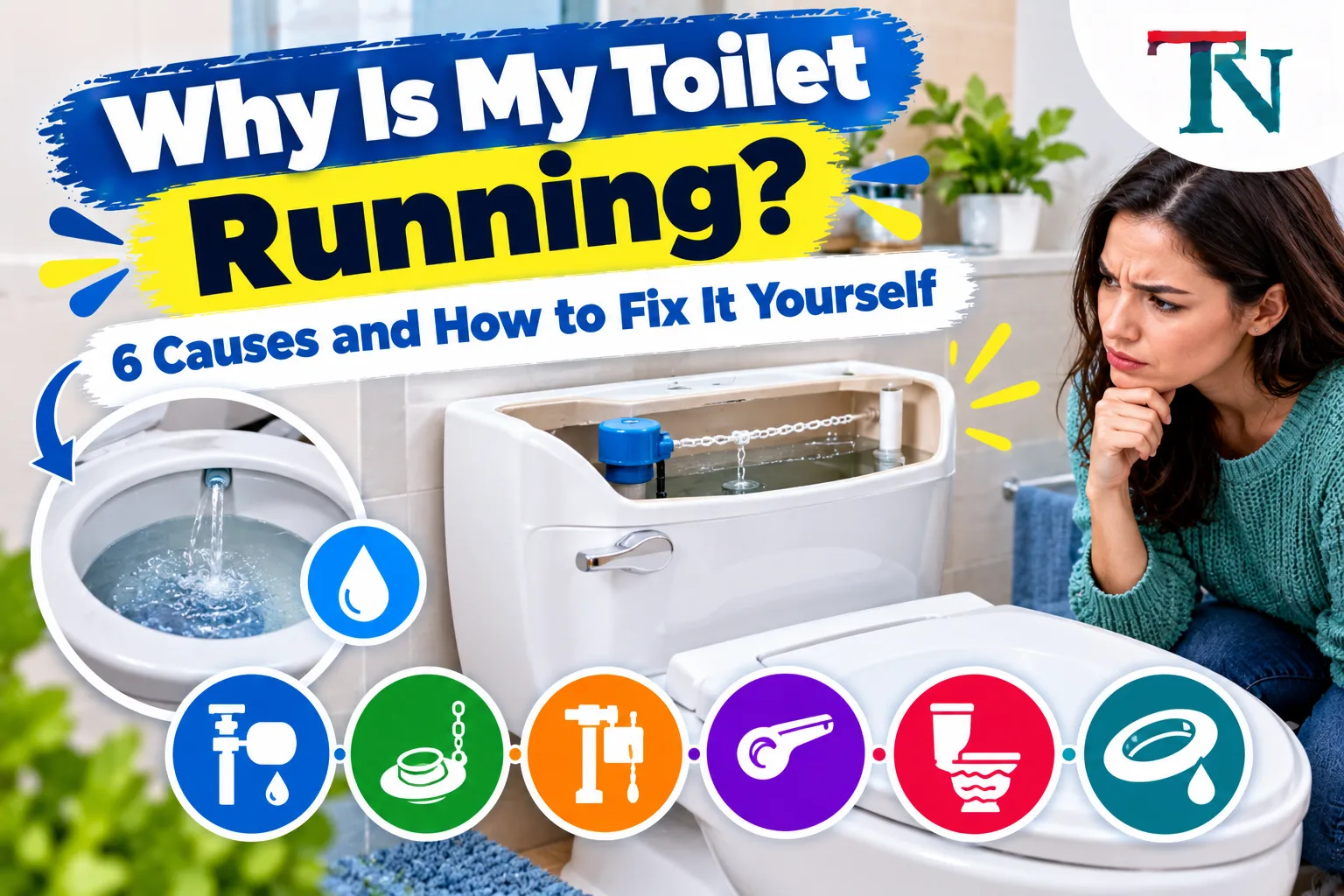
Why Is My Toilet Running? 6 Causes and How to Fix It Yourself
A running toilet can waste up to 200 gallons of water a day. Find the cause in minutes and fix it yourself, usually with a cheap flapper or a quick adjustment.
On this page
A toilet keeps running because water is leaking out of the tank or the tank is overfilling. The most common cause is a worn-out flapper, the rubber seal at the bottom of the tank. Other causes are a chain that is the wrong length, a float set too high, a bad fill valve, or a refill tube in the wrong spot.
A running toilet is more than annoying. The EPA says a leaky toilet can waste about 200 gallons of water every day. That can add a lot to your water bill.
The good news is that most running toilets are easy to fix yourself. You usually need no special tools, and the parts cost just a few dollars.
How a toilet tank works
It helps to know what is inside the tank. Take the lid off and set it somewhere safe. It is heavy and can break. Here are the main parts:
- Flapper: A rubber seal at the bottom of the tank. When you flush, it lifts up and lets water rush into the bowl. Then it drops back down to seal the tank.
- Chain: Connects the flush handle to the flapper.
- Fill valve: The tall part on one side of the tank. It refills the tank with water after you flush.
- Float: A plastic cup or ball that rises with the water. When it gets high enough, it tells the fill valve to shut off.
- Overflow tube: The open pipe in the middle of the tank. If the water gets too high, it spills down this tube into the bowl so it does not overflow onto the floor.
- Refill tube: A small, bendy tube that sends a little water into the overflow tube to refill the bowl.
When everything works, the tank fills, the float rises, the water shuts off, and the flapper stays sealed. When any part fails, the toilet keeps running.
First, find where the water is going
Look inside the tank while the toilet is running.
- Is water spilling into the overflow tube? Then the water level is too high. The problem is the float or the fill valve.
- Is the water level below the top of the overflow tube? Then water is probably leaking past the flapper into the bowl.
The food coloring test
This simple test tells you if the flapper is leaking.
- Put 5 to 10 drops of food coloring into the tank water.
- Do not flush. Wait at least 10 minutes (the EPA suggests checking after about 10 minutes; waiting a little longer can catch very slow leaks).
- Look in the bowl.
If you see colored water in the bowl, the flapper is leaking. Flush afterward so the color does not stain the bowl.
6 reasons your toilet keeps running
1. The flapper is worn out
This is the most common cause by far. Over time, the rubber flapper gets stiff, warped, or covered in minerals. It no longer seals tightly, so water slowly leaks into the bowl. The tank keeps refilling to replace it.
Signs:
- The food coloring test shows color in the bowl
- The toilet refills by itself every so often
- You hear a hissing or trickling sound
How to fix it:
- Turn off the water. Turn the valve behind the toilet clockwise until it stops.
- Flush to empty the tank.
- Unhook the chain from the handle arm.
- Unhook the old flapper from the two pegs on the sides of the overflow tube, or slide it off if it has a ring.
- Take the old flapper to the hardware store so you can match it. Flappers usually come in 2-inch and 3-inch sizes.
- Attach the new flapper the same way.
- Hook the chain back on, leaving just a little slack.
- Turn the water back on and let the tank fill. Flush a few times to test it.
Tip: Before you buy a new flapper, try cleaning the rim where the flapper sits. Mineral buildup can stop a good flapper from sealing. Gently scrub it with a scrub pad.
2. The chain is too long or too short
The chain connects the handle to the flapper.
- Too short: The chain holds the flapper up a little, so it cannot close all the way. Water keeps flowing.
- Too long: Extra chain can get caught under the flapper and stop it from sealing.
How to fix it: Adjust the chain so there is about half an inch of slack when the flapper is closed. Most chains have a clip you can move to a different link. Cut off extra chain if it keeps getting in the way.
3. The float is set too high
If the float is too high, the tank fills with too much water. The extra water spills down the overflow tube, and the fill valve keeps running.
The water level should usually be about 1 inch below the top of the overflow tube. Many tanks have a line marked on the inside to show the right level.
How to fix it:
- Cup float (a cup that slides up and down the fill valve): Find the long adjustment screw or clip on the side of the fill valve. Turn the screw or slide the clip to lower the float.
- Ball float (a ball on the end of a metal arm): Turn the screw on top of the fill valve where the arm connects. Or gently bend the arm down a little.
Flush and let the tank refill. Check that the water stops about an inch below the top of the overflow tube.
4. The fill valve is bad
The fill valve can wear out after many years. It may not shut off, even when the float is set right. You might hear hissing, or the water may keep rising.
How to test it: Lift the float up with your hand. If the water keeps running even with the float lifted, the fill valve is broken.
How to fix it: Fill valves are cheap and come with instructions. You need to turn off the water, empty the tank, unscrew the water supply line under the tank, and swap the old valve for a new one. If you are not comfortable doing that, a plumber can do it quickly.
5. The refill tube is in the wrong place
The small refill tube should clip onto the top of the overflow tube, with its end above the water. If the tube is pushed down into the overflow tube and under the water, it can suck water out of the tank. This makes the tank keep refilling.
How to fix it: Clip the refill tube so its end sits just above the top of the overflow tube, not inside the water.
6. The handle sticks
If the flush handle sticks in the down position, the flapper stays open and water keeps running.
How to fix it: Check that the handle moves freely. Tighten the nut inside the tank that holds the handle. Note that this nut usually turns the opposite way from normal nuts. If the handle is loose or broken, replace it.
Quick guide: what you see and what to do
| What you notice | Most likely cause | Fix |
|---|---|---|
| Color shows in the bowl after the food coloring test | Worn flapper | Clean the seat or replace the flapper |
| Water spills into the overflow tube | Float set too high | Lower the float |
| Water keeps running with the float lifted | Bad fill valve | Replace the fill valve |
| Toilet refills by itself every few minutes | Slow flapper leak | Replace the flapper |
| Runs until you jiggle the handle | Chain too long or sticky handle | Adjust the chain; tighten or replace the handle |
| Hissing sound, water level looks normal | Refill tube under water or fill valve | Clip the refill tube above the water |
What you need
For most running toilet fixes, you only need:
- A new flapper or fill valve (if needed)
- A sponge and towel to soak up leftover water
- Rubber gloves
- A small bucket
- A scrub pad
- An adjustable wrench (for a fill valve swap)
Why does my toilet run by itself every few minutes?
If your toilet turns on for a few seconds and then stops, over and over, it is called phantom flushing. It means water is slowly leaking out of the tank. The tank refills when the level drops too low. The most common cause is a worn flapper. Do the food coloring test, then replace the flapper if needed.
Why is my toilet running after I replaced the flapper?
If it still runs with a new flapper, check these things:
- The new flapper is the right size and type for your toilet.
- The chain has about half an inch of slack.
- The flapper seat (the rim it sits on) is clean and not cracked.
- The water level is not spilling into the overflow tube.
- The refill tube is clipped above the water.
If none of these fix it, the fill valve or the flush valve may need to be replaced.
Is water leaking on the floor too?
A running toilet usually does not leak onto the floor. If you see water around the base of the toilet, it could be a bad wax seal, a loose supply line, or a cracked tank. A broken wax seal can also let sewer gas into your bathroom. Our guide on why your house smells like sewage explains how to spot a bad toilet seal.
Water on the floor can also soak into the subfloor and cause damp and mold. If your bathroom smells stale, see our guide on getting rid of a musty smell.
How to prevent a running toilet
- Check your toilet once a year with the food coloring test.
- Do not use bleach tablets that sit in the tank. They can wear out the rubber flapper faster.
- Replace the flapper every few years, or when it gets stiff.
- Listen for hissing or refilling when no one has flushed.
- Check your water bill. A sudden jump can mean a hidden leak.
Hidden leaks can also lower the pressure at your faucets. If your showers feel weak, see our guide on boosting weak water pressure at home.
When to call a plumber
You can fix most running toilets yourself. Call a plumber if:
- The toilet still runs after you replaced the flapper and fill valve
- The tank or bowl is cracked
- Water is leaking onto the floor
- The water shut-off valve behind the toilet will not turn or is leaking
- You do not feel comfortable taking apart the tank parts
Recap
Most running toilets are caused by a worn flapper, a chain that is the wrong length, or a float set too high. Use the food coloring test to find a leaking flapper, and check if water is spilling into the overflow tube. A new flapper costs just a few dollars and takes about 15 minutes to install. Fixing it quickly can save you hundreds of gallons of water every day.
Sources
This guide was checked against these official and manufacturer sources.
Frequently asked questions
Is a running toilet an emergency?
No, it is not usually an emergency, but you should fix it soon. A running toilet can waste up to 200 gallons of water a day and raise your water bill. If the toilet is overflowing onto the floor, turn off the water valve behind the toilet right away.
Why does my toilet run for a few seconds every so often?
This is called phantom flushing. It usually means water is slowly leaking from the tank into the bowl, most often through a worn flapper. When the water level in the tank drops, the fill valve turns on for a few seconds to refill it. Replacing the flapper usually fixes it.
How much does it cost to fix a running toilet?
If you do it yourself, a new flapper costs about $5 to $15, and a new fill valve costs about $10 to $30. A plumber will usually charge more for labor. Many running toilets can be fixed for under $20 in less than an hour.
Can I jiggle the handle to stop a running toilet?
Jiggling the handle can stop it for a moment by helping the flapper fall back into place. But if you have to do it often, something is wrong, like a chain that is too long or a worn flapper. Fix the real problem to stop wasting water.

Written by
Agha Ali Abbas
Agha Ali Abbas is the founder and editor of TimeToNote. He has worked in SEO and content writing for 18 years, and he checks every guide against manufacturer documentation and official sources before it goes live.
Related guides
Home Problems
Why Does My House Smell Like Sewage? 9 Causes and Easy Fixes
A sewage smell in your house usually comes from a dry drain trap, a bad toilet seal, or a blocked vent. Find the cause fast and fix it with these simple steps.
11 min read

Home Problems
Why Does My Room Smell Musty? Causes and How to Get Rid of the Smell
A musty smell almost always means damp air and mold or mildew nearby. Learn how to find the source, remove the smell, and stop it from coming back.
8 min read
Home Problems
Hidden Water Leaks: 9 Warning Signs and How to Find Them
A hidden water leak can quietly damage your home and raise your bill. Learn 9 warning signs, a simple water meter test, how to check toilets, and when to call a plumber.
7 min read
More guides you may need
Home Problems
Dryer Keeps Blowing the Thermal Fuse? Why It Happens and How to Fix It
Dryer thermal fuse blows again and again? The fuse is a symptom of overheating. Check the vent first, then the thermostats, element and control board.
7 min read
Home Problems
Dryer Keeps Running When the Door Is Open? Causes and Safe Fixes
Dryer drum keeps turning with the door open, or will not stop? Unplug it, then check the door switch and latch, the timer, wrinkle prevent and sensor bars. Safe steps.
6 min read