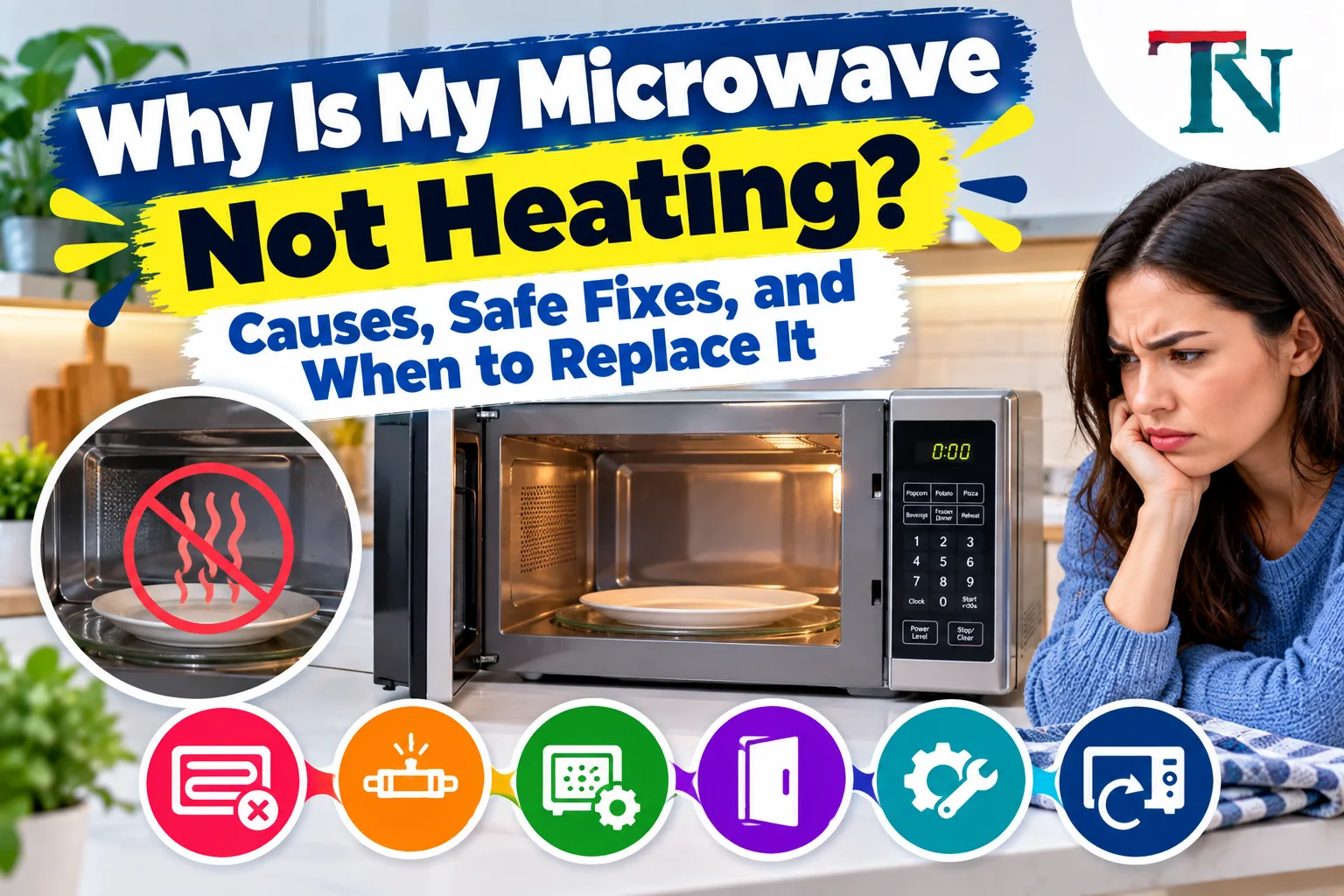
Why Is My Microwave Not Heating? Causes, Safe Fixes, and When to Replace It
Microwave running but food stays cold? Learn the common causes, the safe fixes you can try yourself, and when it is time to repair or replace it.
On this page
If your microwave runs but does not heat, the cause is usually one of these: a setting problem (like low power or demo mode), a door that is not closing properly, a power problem, or a failed part inside, such as a door switch or the magnetron that makes the heat. Some of these are easy to fix. Others need a trained technician because the parts inside a microwave are dangerous.
This guide shows you the safe checks you can do yourself, explains what is likely wrong inside, and helps you decide whether to repair or replace your microwave.
First, test if it really is not heating
Sometimes food just needs more time. A quick test tells you for sure.
- Fill a microwave-safe cup with 1 cup of cold water.
- Heat it on high for 1 minute.
- Carefully touch or taste the water.
If the water is warm or hot, your microwave is heating, and it may just be weaker than you expected. If it is still cold, something is wrong. Keep reading.
Safe fixes you can try yourself
1. Check the power level
Many microwaves let you set the power level from 1 to 10. If someone set it to a low level, food will heat very slowly.
Fix: Press Power or Power Level and set it to 10 or High. Check your manual if you are not sure how.
2. Turn off demo mode
Many microwaves have a demo mode used in stores. In demo mode, the light, fan, and turntable work, and the timer counts down, but nothing heats. It can get turned on by accident.
Fix: Look for "Demo" or "D" on the display. Check your manual for how to turn it off. On many models, you hold a button like Start, Clear, or 0 for a few seconds. Unplugging the microwave for a minute can also reset it on some models.
3. Check the child lock
A child lock (control lock) can stop the microwave from starting. You may see a lock symbol or "LOC" on the display.
Fix: On many models, you hold Stop/Cancel or Start for 3 seconds to unlock it. Check your manual.
4. Make sure the door closes fully
Microwaves have door switches that stop them from heating unless the door is fully closed. This is an important safety feature. If food, grease, or a bent latch keeps the door from closing all the way, the microwave may not start or may not heat.
Fix:
- Clean the door edges, latch, and the area around the door frame.
- Open and close the door firmly. You should hear a click.
- Look for a broken or bent latch hook.
If the door looks damaged or does not close properly, stop using the microwave. A damaged door can let microwave energy leak out.
5. Check the outlet and circuit breaker
A microwave needs a lot of power. If the outlet is weak or loose, it may not heat well.
Fix:
- Plug the microwave straight into a wall outlet, not an extension cord or power strip.
- Check your home's circuit breaker panel for a tripped breaker.
- If the outlet is a GFCI outlet (with Test and Reset buttons), press Reset.
- Try another appliance in the same outlet to see if it works.
- Do not run the microwave on the same circuit as other big appliances, like a toaster oven or coffee maker, at the same time.
6. Check your dish
Some dishes absorb microwave energy and get hot while the food stays cold. Others reflect it.
Fix: Use dishes marked microwave safe. Glass and most ceramic dishes work well. Never put metal, foil, or dishes with metal trim in the microwave. If you see sparks, stop the microwave right away.
What is probably wrong inside
If the safe checks did not help, a part inside has likely failed. Here are the most common ones. These repairs are not do-it-yourself jobs for most people because of the high voltage inside.
Door switches
Most microwaves have two or three door switches. If one fails, the microwave may light up and spin but not heat. It may also blow an internal fuse.
Magnetron
The magnetron is the part that creates the microwaves that heat your food. When it wears out or fails, the microwave will run normally but will not heat at all. Signs can include a loud humming or buzzing sound, or a burning smell.
High-voltage diode and capacitor
The diode and capacitor work with the magnetron to power it. If either one fails, the microwave will not heat. The capacitor is the part that can hold a dangerous charge even after unplugging.
Internal fuse
A fuse inside the microwave protects it from power surges. If it blows, the microwave may not turn on at all, or it may stop heating. A blown fuse often means another part, like a door switch, has failed too.
Control board
The control board is the microwave's brain. If it fails, the microwave may not send power to the heating parts, even though the display and buttons work.
Cheat sheet
| What you notice | Likely cause | What to do |
|---|---|---|
| Runs, but "Demo" or "D" is on the display | Demo mode | Turn off demo mode |
| Heats very slowly | Low power level | Set power to 10 or High |
| Lock symbol on display, will not start | Child lock | Hold Stop or Start to unlock |
| Will not start, door feels loose | Door not closing or door switch | Clean the door and latch; call a technician if damaged |
| Nothing works at all | Outlet, breaker, or internal fuse | Check the outlet and breaker; then call a technician |
| Runs, spins, but no heat, loud hum | Magnetron, diode, or capacitor | Call a technician or replace |
| Sparks inside | Metal in the microwave or damaged cover | Stop right away; remove metal; get it checked |
Why is my microwave sparking?
Sparks inside a microwave are called arcing. Common causes include:
- Metal, foil, or dishes with metal trim
- Food splatter burned onto the walls
- A damaged waveguide cover, a small panel (often made of mica) on the inside wall
Fix: Stop the microwave right away. Remove any metal. Clean the inside walls. If the waveguide cover is burned or damaged, it can be replaced, but if sparking continues, stop using the microwave and have it checked.
Why does my microwave make a loud noise?
A gentle hum is normal. But a loud buzz, grinding, or rattling sound can mean a problem:
- Grinding or scraping: The turntable or its roller ring may be off track. Take them out, clean them, and set them back in place.
- Loud humming or buzzing with no heat: Often a failing magnetron or high-voltage part. Stop using it and call a technician.
- Clicking: A little clicking is normal on low power levels, because the microwave turns on and off. Loud or constant clicking on high power may mean a failing part.
Should you repair or replace your microwave?
Here is a simple way to decide:
- Age: Many microwaves last about 7 to 10 years. If yours is near that age, replacing it usually makes more sense.
- Cost: A common rule is to replace an appliance if the repair costs more than about half the price of a new one. Magnetron repairs can cost as much as a basic new countertop microwave.
- Type: Over-the-range and built-in microwaves cost more to replace and install, so repairing them is more often worth it.
- Safety: If the door is damaged, the microwave sparks often, or you smell burning, it is safer to replace it.
How to make your microwave last longer
- Never run it empty. Running a microwave with nothing inside can damage the magnetron.
- Keep it clean. Wipe up splatters so they do not burn onto the walls.
- Cover food with a microwave-safe lid or paper towel to stop splatters.
- Close the door gently. Slamming it can wear out the latch and switches.
- Use the right dishes, and never use metal.
- Keep the vents clear, especially on over-the-range models.
How to clean your microwave the easy way
A clean microwave works better and smells better.
- Fill a microwave-safe bowl with 1 cup of water and a few slices of lemon or 1 tablespoon of white vinegar.
- Heat it on high for 3 to 5 minutes, until the window steams up.
- Leave the door closed for 5 more minutes to let the steam loosen the mess.
- Carefully remove the bowl, which will be hot.
- Wipe the inside with a damp cloth or sponge.
- Wash the turntable in warm, soapy water.
A clean kitchen also makes it easier to keep out pests like fruit flies. And if your fridge is acting up too, see our guide on what to do when the fridge is not cooling but the freezer is.
When to call a technician
Call an appliance repair technician if:
- The microwave runs but still does not heat after the safe checks
- It will not turn on at all, and the outlet and breaker are fine
- You hear loud humming, buzzing, or grinding
- You smell burning or see sparks that do not stop
- The door is damaged or does not close properly
Have your model number ready. It is usually on a sticker inside the door frame or on the back of the microwave.
Key points
When your microwave runs but does not heat, start with the safe checks. Test it with a cup of water, set the power level to high, turn off demo mode and child lock, make sure the door closes fully, and check the outlet and breaker. If it still will not heat, a part like the door switch or magnetron has likely failed. Never open the case yourself. Call a technician, or replace the microwave if it is old or the repair costs too much.
Sources
This guide was checked against these official and manufacturer sources.
Frequently asked questions
Why does my microwave run but not heat?
When a microwave lights up, spins, and makes noise but does not heat, the problem is usually a bad door switch or a failed part in the high-voltage system, such as the magnetron, diode, or capacitor. These parts are dangerous to work on and should be checked by a trained technician.
Is it safe to fix a microwave myself?
Only simple checks are safe for most people, like checking the outlet, the settings, the door, and the circuit breaker. Do not open the microwave's outer case. It contains a capacitor that can store a deadly electric charge even when the microwave is unplugged.
How long do microwaves last?
Many microwaves last about 7 to 10 years with normal use. If yours is older and has stopped heating, replacing it is often cheaper than repairing it.
Why is my microwave heating unevenly?
Uneven heating is often normal. Microwaves heat in patterns, so some spots get hotter than others. Use a turntable, stir food halfway through, cover it loosely, and let it stand for a minute after cooking. If the turntable stopped spinning, check that it is seated correctly.

Written by
Agha Ali Abbas
Agha Ali Abbas is the founder and editor of TimeToNote. He has worked in SEO and content writing for 18 years, and he checks every guide against manufacturer documentation and official sources before it goes live.
Related guides
Home Problems
Fridge Not Cooling but Freezer Is Cold? 8 Causes and How to Fix It
Freezer is cold but the fridge is warm? Learn the 8 most common causes, from blocked vents to frost on the coils, and simple fixes you can try today.
8 min read
Home Problems
Why Is My Dishwasher Not Draining? 9 Causes and Easy Fixes
Water sitting in the bottom of your dishwasher? Learn why it will not drain and how to fix it yourself, from cleaning the filter to checking the drain hose.
8 min read
Home Problems
Microwave Keeps Running or Starts When the Door Is Open? What to Do
Microwave keeps running or starts with the door open? Stop using it. Learn what the door switches do, what is normal, and what to ask a technician.
6 min read
More guides you may need
Home Problems
Air Fryer Keeps Tripping the Breaker? Causes and Safe Fixes
Air fryer tripping the breaker or GFCI? Check the circuit load, outlet, cord and the fryer itself. Here is how to find the cause without guessing.
6 min read
Home Problems
Bathroom Fan Not Pulling Air? Causes and Fixes
Bathroom exhaust fan weak, loud or not pulling air? Do the tissue test, clean the grille and check the duct and outside vent. Here is what to fix first.
4 min read