Why Does My Refrigerator Have Ice in the Bottom? Causes and Fixes
Ice or a puddle at the bottom of your fridge or freezer? A clogged defrost drain is the usual cause. Here is how to thaw it, clear it and stop it coming back.
On this page
Ice or a puddle at the bottom of a refrigerator or freezer usually means the defrost drain is clogged. Melted frost cannot run away, so it backs up, spreads across the floor of the compartment and freezes. Empty the fridge, thaw it fully, flush the drain with warm water, and check the door seal and defrost system if the ice returns.
You open the freezer and find a sheet of ice under the baskets. Or you pull out the crisper drawers and see a pool of water, or even a block of ice, in the fridge section. It looks worrying, and it is easy to start picking at the ice. Do not. The ice itself is not the problem. It is a clue to what is going wrong inside the cooling system, and once you understand how the fridge defrosts itself, the fix is simple.
How a modern fridge defrosts itself
Most fridges and freezers today are "frost-free". Behind a panel at the back of the freezer sits a cold coil called the evaporator. As it cools the air, frost builds up on it. Every several hours a small heater warms the coil, and the frost melts. The water runs through a drain hole at the bottom of the freezer, down a tube, and into a shallow pan under the fridge, where it evaporates.
That chain has several parts, and when one of them fails, water ends up in the wrong place:
- The evaporator coil, which collects frost.
- The defrost heater, which melts it.
- The defrost timer or control board, which starts and stops the heater.
- The defrost thermostat or sensor, which tells the heater to stop.
- The drain hole and drain tube, which carry the water away.
- The drain pan under the fridge.
The most common failure, by a long way, is a blocked drain. A defrost heater or sensor failure is the next most common cause.
Cause 1: A clogged defrost drain
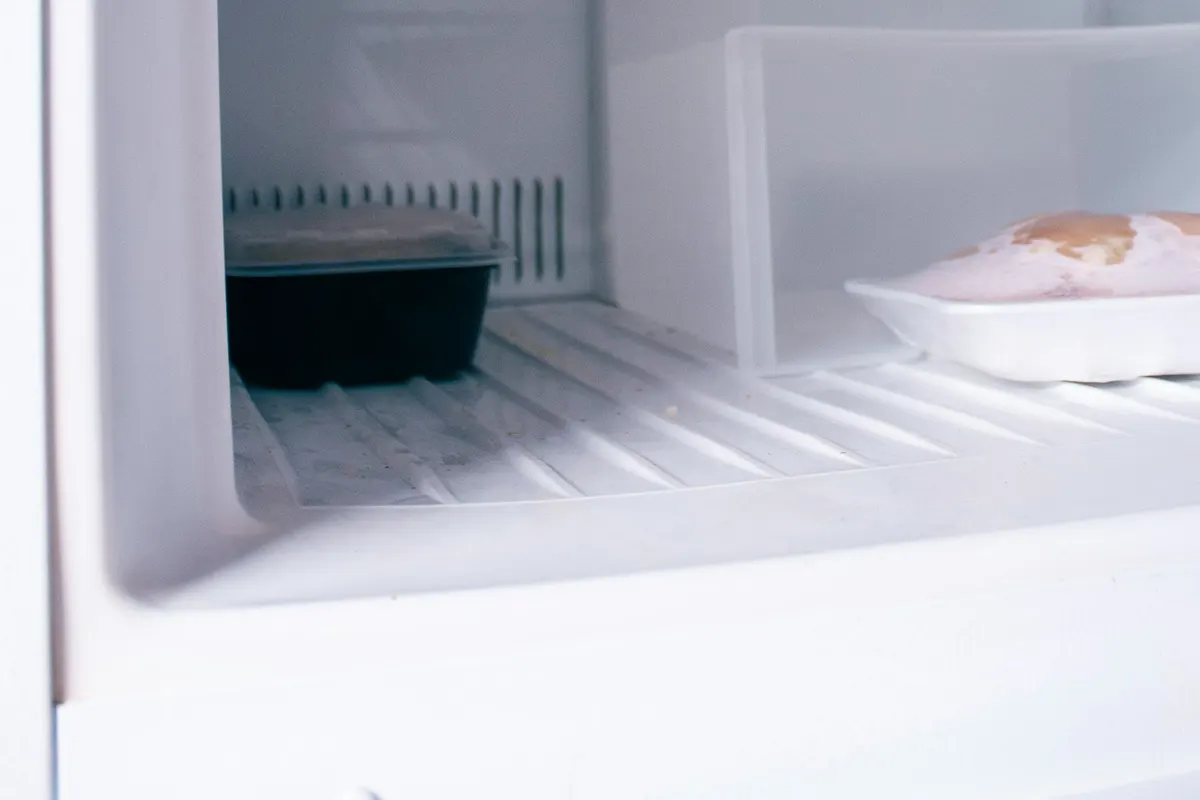
This is the usual answer. Food crumbs, bits of packaging and ice can plug the small drain hole at the back of the freezer. The meltwater then has nowhere to go. It flows across the freezer floor, and when the cycle ends it freezes again. After a few weeks you have a thick layer of ice. If the water finds a path into the fridge section, you may see a puddle under the crisper drawers.
Signs:
- Ice forms on the freezer floor, usually starting at the back.
- Water collects under the crisper drawers in the fridge.
- The ice returns a few days after you clear it.
- Sometimes there is a trickling or dripping sound at the back.
How to fix it:
- Move your food. Put frozen food in a cooler with ice packs and the fridge food in another cooler. Never let frozen food thaw and refreeze.
- Unplug the fridge or switch off the cooling at its control.
- Open the doors and lay towels on the floor. Let the ice melt fully. For a thick layer this can take 6 to 24 hours. A pan of hot water, placed on the freezer floor, speeds it up. Do not chip at the ice with a knife or screwdriver, because the coils and walls are easy to puncture.
- Take out the shelves and drawers that are in the way, and remove the back panel inside the freezer if your manual shows how. This gives you access to the drain hole.
- Find the drain hole, a small opening at the bottom center or corner of the back wall.
- Flush it with warm water. Use a turkey baster, a large syringe or a squeeze bottle. Repeat until water runs freely and you hear it reach the drain pan below. A mix of warm water and a little baking soda can loosen residue. Do not use hot or boiling water in plastic parts or use sharp tools.
- Clear stubborn blockages with a pipe cleaner or a length of flexible plastic tubing. Push gently and do not force it.
- Check and clean the drain pan under the fridge. It sits behind the kick grille at the bottom front, or at the back. It may hold slimy residue that makes a smell.
- Dry everything, reassemble, plug in the fridge, and let it cool before you put food back.
The drain valve
Many fridges have a small rubber valve at the end of the drain tube, often shaped like a duckbill. It keeps warm air out and lets water through. Pull the fridge out from the wall, remove the service panel at the back, and look for it. If it is clogged with debris, wash it in warm soapy water and put it back. If it is cracked or stiff, replace it, because it is a cheap part.
Cause 2: The drain has frozen
Sometimes the drain is not blocked by food but by ice. If the drain tube freezes, water cannot pass, and the ice grows from there. This often happens when the defrost heater around the drain has failed, or when a poor seal lets in warm humid air that freezes in the cold tube.
A full thaw usually clears this, but if the ice returns in a week or two, the defrost heater is the likely cause. See Cause 4.
Cause 3: A door gasket that does not seal
If the rubber seal around the freezer or fridge door is torn, dirty, warped or hardened, warm humid air gets in. That moisture freezes as frost on the coil, as ice on the floor, and sometimes as ice around the door. The defrost cycle cannot cope with the extra water.
Try the dollar-bill test. Close the door on a bill, so that half is inside and half outside. Pull gently. If it slides out with no resistance, the seal is weak at that spot. Test at several points around the door.
To fix it:
- Wipe the gasket with warm soapy water, then dry it. Sticky residue stops it sealing.
- Gently warm a stiff or curled gasket with a hair dryer on low and press it back into shape.
- Make sure the fridge is level and the door closes fully by itself. Adjust the front feet if needed. A fridge tilted slightly back so that the door swings shut is better than one tilted forward.
- Replace the gasket if it is cracked or torn. Many models have a seal that pulls out of a groove and a new one that presses in.
Cause 4: A failed defrost heater, thermostat or timer
If the drain is clear and the door seal is good, but a thick layer of frost keeps forming, the defrost system may have failed. The signs are different from a simple clog:
- Heavy frost on the back wall of the freezer, not only ice on the floor.
- A fridge that warms up because the coil is covered in ice and cannot cool air properly. Our guide on a fridge that is not cooling while the freezer is cold covers this, because an iced-over evaporator is one of the main causes.
- The ice comes back about a week after a full thaw.
Testing a defrost heater, sensor or timer takes a multimeter and some comfort with removing panels. If you do not have that, this is a good point to call an appliance repair person. Parts are often inexpensive, but diagnosing the right one saves a lot of guesswork.
Cause 5: The doors are left open or overfilled
Warm air gets in every time the door opens, and moisture comes with it. Leaving the door ajar even slightly, or packing items so tightly that the door will not shut flush, adds humidity and frost.
- Check that no bottle, tray or bag keeps the door from closing.
- Do not open the door for long, and do not put hot food inside before it cools.
- Cover liquids and leftovers so their moisture does not enter the air.
- Leave a little space around items so air can flow to the vents.
Cause 6: Food or liquid has leaked or spilled
A broken carton, a leaking container or a spill under the drawers can freeze into a sheet of ice that looks like a drain problem. If you can see colored or sticky ice, a spill is likely. Thaw, clean and dry the compartment, and check the drain to be sure it is not also blocked.
Cause 7: A blocked or iced ice maker line
If your fridge has an ice maker or a water dispenser and the ice is near the ice maker, the water supply line or fill tube may be leaking or frozen. Water drips into the freezer and freezes in a lump. If that sounds like your situation, read ice maker problems and frozen fill tubes, which covers frozen fill tubes and water line problems.
Ice at the bottom of the fridge section versus the freezer
| Where you see it | Most likely cause |
|---|---|
| A sheet of ice on the freezer floor | Clogged or frozen defrost drain |
| Water under the crisper drawers | Defrost water redirected into the fridge, or a blocked drain |
| Ice that forms around the door | Weak gasket or door left open |
| Heavy frost on the back wall | Defrost heater, sensor or timer fault |
| Ice around the ice maker or dispenser | Water line leak or frozen fill tube |
| Puddle on the kitchen floor | Overflowing drain pan or blocked drain tube |
What not to do
- Do not chip the ice with a metal tool. It is easy to puncture the evaporator coils, which can ruin the fridge.
- Do not use a heat gun or a very hot hair dryer on plastic parts. A hair dryer on low is fine, held a safe distance away.
- Do not keep the fridge on during a thaw. Unplug it, or you waste energy and the ice melts very slowly.
- Do not refreeze thawed food. Keep it cold in a cooler and use it, or throw it away if it has been above safe temperatures for too long.
Food safety during a thaw
Food safety guidance says the fridge should be at 40 degrees Fahrenheit (4 degrees Celsius) or below and the freezer at 0 degrees Fahrenheit (minus 18 degrees Celsius). During a long thaw, move food to coolers with ice. A refrigerator thermometer is a cheap way to check. If food has been above 40 degrees for more than about two hours, throw away perishable items such as meat, dairy and leftovers.
How to stop it coming back
- Clean the defrost drain every six months with warm water and a baster, even if nothing is wrong.
- Keep food away from the back wall of the freezer so it does not block the drain or the vents.
- Wipe the door gaskets monthly, and check the seal with the dollar-bill test twice a year.
- Do not overfill the fridge or freezer. Leave room for air to move.
- Keep the fridge level and away from heat sources such as an oven or direct sun.
- Set the temperatures correctly, around 37 degrees in the fridge and 0 in the freezer. Settings that are too cold can promote frost.
- Let hot food cool a little before storing it, and cover liquids.
When to call a repair person
Call for help if:
- The ice returns within two weeks of a full thaw and a drain flush.
- There is heavy frost on the back wall or the fridge section is warm.
- You cannot reach the drain or find the back panel.
- The compressor runs without stopping, or you hear clicking, buzzing or other new noises.
- The fridge is old and the repair quote is high. Compare the repair price with a new, more efficient model.
What we could not verify
Fridge layouts differ a lot, so the location of the drain, the back panel and the pan varies by brand and model. Always check your manual before removing panels. Thaw times depend on how much ice has built up, and repair costs depend on the part and your area, so we have not given fixed prices.
The short version
Ice at the bottom of a fridge or freezer is nearly always meltwater that could not escape. Unplug the unit, thaw it fully, flush the defrost drain with warm water, and clean the drain pan. Then check the door seal, keep food away from the back wall, and watch whether ice returns. If it does, the defrost heater, sensor or timer is the next suspect, and a repair person can test them.
Sources
This guide was checked against these official and manufacturer sources.
Frequently asked questions
Why is there ice at the bottom of my freezer?
In most cases the defrost drain is blocked. During a defrost cycle the frost on the evaporator melts and should run down a small drain to a pan under the fridge. If food debris or ice blocks the drain, the water backs up, spreads across the floor of the freezer and freezes into a sheet of ice.
Why is there water at the bottom of my fridge section?
The same blocked defrost drain can also send water into the fridge section, where it collects under the crisper drawers. A cracked drain tube, a poorly sealed door, or a drain line that has frozen over can cause it as well.
How do I thaw the ice and clear the drain?
Empty the fridge, unplug it and leave the doors open for several hours, up to a day for heavy ice, with towels on the floor. Then flush the defrost drain with warm water from a turkey baster or syringe until it runs freely. Plug the fridge in again once everything is dry.
Can a bad door seal cause ice at the bottom?
Yes. A door gasket that does not seal lets warm, humid air into the freezer. The moisture freezes into frost and ice, and it builds up faster than the defrost cycle can handle. A dollar-bill test, where a bill slides out easily when the door is closed on it, can show a weak seal.
Is it safe to keep food in a fridge with ice and water at the bottom?
If the fridge and freezer are still cold enough, usually yes, but check the temperatures. Food safety guidance says to keep the refrigerator at or below 40 degrees Fahrenheit and the freezer at 0 degrees. Move food to a cooler while you thaw the unit, and throw away anything that was above those temperatures for too long.

Written by
Agha Ali Abbas
Agha Ali Abbas is the founder and editor of TimeToNote. He has worked in SEO and content writing for 18 years, and he checks every guide against manufacturer documentation and official sources before it goes live.
Related guides
Home Problems
Fridge Not Cooling but Freezer Is Cold? 8 Causes and How to Fix It
Freezer is cold but the fridge is warm? Learn the 8 most common causes, from blocked vents to frost on the coils, and simple fixes you can try today.
8 min read
Home Problems
Why Is My Ice Maker Not Working? 10 Causes and Easy Fixes
Fridge ice maker not making ice? Check these 10 common causes, from a switched-off ice maker to a frozen fill tube, and fix most of them in minutes.
7 min read
Home Problems
Why Is My Dehumidifier Running but Not Collecting Water? 9 Fixes
Dehumidifier running but the bucket stays empty? Check the room humidity, temperature, frozen coils, filter and sensor, then test the compressor. Step by step.
9 min read
More guides you may need
Home Problems
Why Does My Gas Stove Keep Clicking? 6 Quick Fixes That Work
Gas stove clicking nonstop or not lighting? Find the cause in minutes with these 6 easy fixes. Plus safety tips and when to call a pro.
10 min read
Home Problems
Why Does My Pilot Light Keep Going Out? Causes and Fixes
A pilot light that keeps going out is most often a dirty or worn thermocouple. Learn the causes, how to relight it safely, and when to call a gas pro.
8 min read