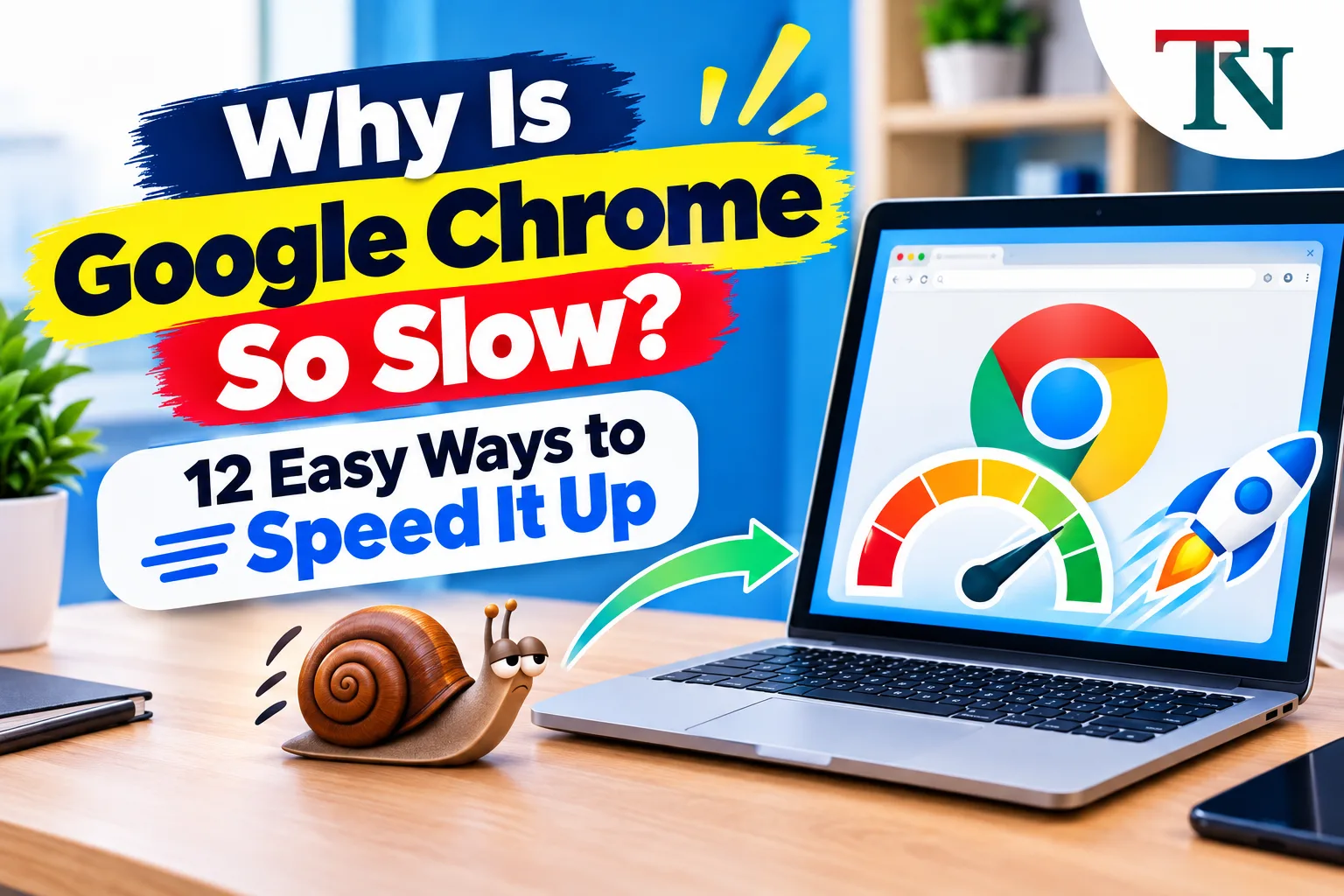
Why Is Google Chrome So Slow? 12 Easy Ways to Speed It Up
Chrome running slow or freezing? Find out why, from too many tabs to heavy extensions, and use these 12 simple fixes to make Chrome fast again.
On this page
Google Chrome gets slow most often because of too many open tabs, too many extensions, a large cache, or an out-of-date browser. Chrome runs every tab and extension as its own process, so each one uses memory. When your computer runs low on memory, everything slows down.
The good news is that you can fix most Chrome slowdowns in a few minutes, without installing anything new.
This guide explains the 12 most common reasons Chrome is slow and how to fix each one. The steps work on Windows, Mac, and Chromebook.
First, find out what is slowing Chrome down
Chrome has its own Task Manager that shows exactly what is using memory and power.
- On Windows: Press Shift + Esc while Chrome is open.
- On Mac or Windows: Click the three dots in the top right, then More tools > Task manager.
Click the Memory column to sort it. The tabs and extensions at the top are using the most. Select anything you do not need and click End process.
This one step often shows you the cause right away.
12 reasons Chrome is slow (and how to fix them)
1. Too many tabs are open
Every open tab uses memory, even if you are not looking at it. Tabs with videos, games, email, or web apps use the most.
Fix:
- Close tabs you do not need.
- Bookmark pages you want to read later instead of keeping them open. Press Ctrl + D (Windows) or Cmd + D (Mac).
- Use tab groups to organize tabs, then close groups you are done with.
2. Memory Saver is turned off
Chrome has a built-in feature that frees up memory from tabs you have not used in a while. The tabs stay open, and they reload when you click them.
Fix:
- Click the three dots > Settings.
- Click Performance.
- Turn on Memory Saver.
On laptops, you can also turn on Energy Saver to make your battery last longer, but it may make Chrome feel a little slower. Turn it off when you need full speed.
3. You have too many extensions
Extensions add helpful features, but each one uses memory and can slow down every page you visit. Some old extensions are poorly made or no longer updated.
Fix:
- Type chrome://extensions in the address bar and press Enter.
- Turn off extensions you do not use every day.
- Click Remove on extensions you do not need at all.
- Turn extensions back on one at a time to find any that slow Chrome down.
Tip: Be careful with extensions you do not remember installing. Remove them, because they may be unwanted software.
4. Your cache and browsing data are too large
Chrome saves parts of websites, called the cache, so they load faster next time. Over months, the cache can get very large or damaged, which can slow Chrome or make pages load incorrectly.
Fix:
- Click the three dots > Delete browsing data (or press Ctrl + Shift + Delete on Windows, Cmd + Shift + Delete on Mac).
- Set the time range to All time.
- Check Cached images and files.
- You can uncheck Cookies if you do not want to be signed out of websites.
- Click Delete data.
Websites may load a little slower the first time you visit them again. Then they speed back up.
5. Chrome is out of date
Old versions of Chrome can be slower and less safe. Chrome usually updates itself, but only when you close and reopen it.
Fix:
- Click the three dots > Help > About Google Chrome.
- Chrome checks for updates and installs them.
- Click Relaunch.
If you never close Chrome, restart it at least once a week so updates can install.
6. Hardware acceleration is causing problems
Hardware acceleration lets Chrome use your computer's graphics chip to make videos and animations smoother. Usually this helps. But on some computers, it causes lag, flickering, or freezing.
Fix:
- Go to Settings > System.
- Turn Use graphics acceleration when available off (or on, if it was off).
- Click Relaunch.
Test both ways to see which one works better on your computer.
7. Your internet connection is slow
Sometimes Chrome is not the problem at all. If websites are slow to load but Chrome itself opens quickly, your internet may be slow.
Fix: Run a speed test in Chrome. Then test the same website in another browser or on your phone. If both are slow, the problem is your connection. Our guide on the most common reasons for slow internet walks you through the fixes.
8. A website is heavy or broken
Some websites are full of ads, videos, and scripts that make Chrome work very hard. One heavy tab can slow down all your other tabs.
Fix: Use Chrome's Task Manager (see above) to find the tab using the most memory or CPU. Close it or refresh it. An ad blocker from a trusted company can also help on ad-heavy sites, but choose one carefully, since extensions use memory too.
9. Preloading or background apps use extra resources
Chrome can preload pages it thinks you will visit, and some apps keep running in the background after you close Chrome.
Fix:
- Go to Settings > Performance and check the Preload pages setting. Turn it to standard or off if your computer has little memory.
- Go to Settings > System and turn off Continue running background apps when Google Chrome is closed.
10. Your Chrome profile is damaged
Sometimes the settings and data in your Chrome profile get mixed up, which can make Chrome slow or glitchy.
Fix: Test with a new profile.
- Click your profile picture in the top right.
- Click Add to create a new profile.
- Use Chrome in the new profile for a while.
If Chrome is fast in the new profile, you can sync your bookmarks and passwords to it and use that one instead.
11. Unwanted software or settings changed Chrome
Some programs change your search engine, homepage, or settings without asking. They can also add pop-ups and slow Chrome down.
Fix:
- Go to Settings > Reset settings > Restore settings to their original defaults.
- Click Reset settings.
This turns off extensions and clears temporary data, but it keeps your bookmarks, history, and saved passwords.
On Windows, also run a full scan with Windows Security. On a Mac, keep macOS updated and check Applications for programs you did not install.
12. Your computer is slow or low on memory
Chrome can only be as fast as your computer. If your computer is old, low on memory (RAM), or has a nearly full hard drive, Chrome will feel slow too.
Fix: Close other programs while you use Chrome, restart your computer, and free up storage. Our guide on fixing a sluggish computer covers startup apps, storage, updates, and more.
Quick checklist to speed up Chrome
Try these steps in order:
- Restart Chrome.
- Open Chrome's Task Manager and end anything using too much memory.
- Close tabs you do not need.
- Turn on Memory Saver.
- Remove extensions you do not use.
- Clear cached images and files.
- Update Chrome.
- Try turning hardware acceleration off or on.
- Test your internet speed.
- Reset Chrome settings if nothing else works.
Why is Chrome slow on my phone?
Chrome on Android and iPhone can also slow down. Try these steps:
- Close tabs. Tap the tab counter at the top or bottom of the screen and close old tabs. Many people have hundreds open without knowing it.
- Clear browsing data. Go to Settings > Privacy and security > Delete browsing data.
- Update Chrome from the Google Play Store or App Store.
- Free up storage. A full phone makes every app slower. Our guide on clearing space on a full phone can help.
- Restart your phone.
How much memory does Chrome need?
There is no exact number, because it depends on how many tabs and extensions you use. But here is a simple guide:
| Computer memory (RAM) | What to expect in Chrome |
|---|---|
| 4 GB | Slow with more than a few tabs; keep tabs and extensions to a minimum |
| 8 GB | Fine for everyday browsing, email, and videos with a handful of tabs |
| 16 GB or more | Comfortable with many tabs, web apps, and video calls at once |
To see how much memory your computer has:
- Windows: Go to Settings > System > About and look at Installed RAM.
- Mac: Click the Apple menu > About This Mac.
If you often keep lots of tabs open on a computer with 4 GB or 8 GB of memory, Memory Saver and fewer extensions will make the biggest difference.
Chrome vs. other browsers
If Chrome is still slow after all of these fixes, try another browser like Microsoft Edge, Firefox, or Safari on the same computer.
- If the other browser is also slow, the problem is likely your computer or internet connection.
- If the other browser is fast, the problem is Chrome's settings, extensions, or profile. A reset or a new profile usually fixes it.
How to keep Chrome fast
- Restart Chrome at least once a week.
- Keep Memory Saver on.
- Only install extensions you really need, and review them every few months.
- Close tabs at the end of the day, or bookmark them.
- Clear your cache every few months.
- Keep your computer updated and restart it regularly.
When to get help
If Chrome is still very slow after trying every step in this guide:
- Try it on another computer to see if the problem follows your account.
- Check the Google Chrome Help Center for known issues.
- Take your computer to a repair shop if everything on it is slow, not just Chrome.
Quick recap
Chrome is usually slow because of too many tabs, too many extensions, a large cache, or an old version. Open Chrome's Task Manager to find the cause, then close tabs, turn on Memory Saver, remove extensions you do not need, clear your cache, and update Chrome. If Chrome is still slow, reset its settings or try a new profile. Most people get a much faster browser in just a few minutes.
Sources
This guide was checked against these official and manufacturer sources.
Frequently asked questions
Why is Chrome so slow all of a sudden?
A sudden slowdown is often caused by a new extension, a website running heavy scripts, a pending Chrome update, or a slow internet connection. Close extra tabs, check Chrome's Task Manager for anything using a lot of memory, and restart Chrome to install any waiting update.
Does clearing the cache make Chrome faster?
It can. A very large or damaged cache can slow Chrome down and cause pages to load wrong. Clearing cached images and files is safe. Sites may load a little slower the first time you visit them again, then speed back up.
Why does Chrome use so much memory?
Chrome runs each tab and extension as a separate process. This makes it more stable, because one broken tab does not crash the whole browser, but it uses more memory. Memory Saver helps by freeing memory from tabs you are not using.
Is Chrome slower than other browsers?
Not always. Speed depends on your computer, your extensions, and how many tabs you use. If Chrome is slow but another browser is fast on the same computer, the problem is likely Chrome's extensions, settings, or profile, and a reset or new profile can help.

Written by
Agha Ali Abbas
Agha Ali Abbas is the founder and editor of TimeToNote. He has worked in SEO and content writing for 18 years, and he checks every guide against manufacturer documentation and official sources before it goes live.
Related guides

Tech Problems
Why Is My Laptop So Slow? 12 Causes and Easy Ways to Speed It Up
Laptop running slow? Find out why, from too many startup apps to a full hard drive, and follow these simple steps to make Windows or Mac laptops fast again.
9 min read
Internet & Apps
Why Is My Internet So Slow? 12 Reasons and How to Speed It Up
Slow internet? Run a quick speed test, then work through these 12 common causes, from an old router to busy evenings, with simple fixes you can try today.
9 min read

Internet & Apps
Taco Bell App Not Working? 10 Quick Fixes That Work
Taco Bell app not loading, won't let you log in, or order won't go through? Try these 10 quick fixes for iPhone and Android, from payment errors to rewards problems.
7 min read
More guides you may need
Internet & Apps
How to Sign Up for Threads (Without Getting Stuck)
Learn how to sign up for Threads with your Instagram login, set up your profile, fix common login problems, and delete or deactivate Threads without losing Instagram.
7 min read

Internet & Apps
WhatsApp Channels vs Telegram Channels: Which Is Better?
WhatsApp Channels and Telegram channels both let you broadcast to followers. See how they differ in privacy, audience size, features, and setup, and which fits you.
7 min read